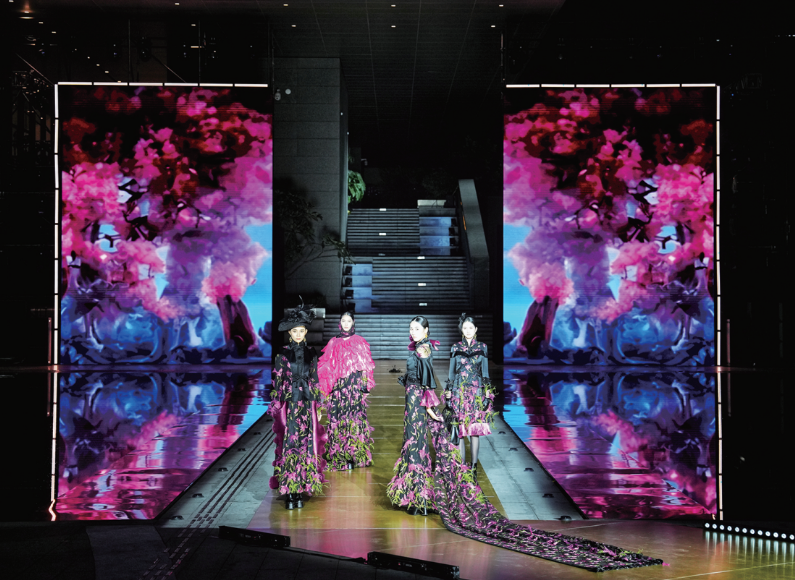
The 2025 Guangzhou Fashion Week will be held in Guangzhou Design Capital.
A tapestry of light and shadow, a surge of creativity. From December 20th to 24th, the 2025 Guangzhou Fashion Week, centered on the theme of "Rooted in Guangzhou, Looking Towards the World," was held at the Design Hall of Guangzhou Design Capital. Representatives from the national garment industry gathered in Baiyun District to witness Guangzhou, as a crucial source and international hub of China's fashion industry, stepping onto the global stage with a brand-new image.
This fashion week is not only a feast of design, but also a declaration of industrial upgrading. Leveraging Guangzhou's robust textile and garment industry, which boasts a foundation exceeding 100 billion yuan, it showcases the latest achievements of the deep integration of original Chinese design power and modern manufacturing systems. It aims to explore practical pathways for design to move from the runway to industry and integrate into the market, sending a powerful Chinese voice to the global fashion system.
Laying the foundation for a trillion-dollar industry.
Forging the strong foundation for "Guangzhou as the global center of the fashion industry."
Before the lights illuminated the runway at the opening ceremony, a set of data highlighted the immense scale of Guangzhou's fashion industry: 187 professional wholesale markets are scattered throughout the city, over 20,000 manufacturing enterprises are clustered together, and the industry's output value is projected to exceed 100 billion yuan in 2024, with exports reaching 46.09 billion yuan. Guangzhou ranks first in the country in both the number of textile and apparel wholesale and retail enterprises and market transaction volume.
“The world looks to China for fashion, and China looks to Guangzhou.” Zhang Shouying, Executive President of the Guangzhou Garment Industry Association and Secretary-General of the Guangzhou Fashion Week Organizing Committee, articulated the industry's confidence. This is not just a slogan, but a reality supported by a complete industrial chain – from fabric and accessory supply, design and pattern making to production, manufacturing, and trade logistics, Guangzhou has built a rapidly responsive, self-evolving "rainforest-like" ecosystem.
As Ji Wenbo, President of the Guangzhou Original Brand Designers Association and Chairman of the Guangzhou Fashion Week Organizing Committee, stated: "Guangzhou's design strength is the strongest in the country, even influencing the international stage. It is not only a 'city of billions in the garment industry,' but also continuously outputs design and brand value." Currently, Guangzhou boasts over 3,000 active clothing brands, forming China's most complete brand matrix. More than 50,000 designers are deeply rooted here, the largest number in the country, injecting a continuous stream of innovative momentum into the industry.
Cultural confidence leads the way.
Opening a new chapter in the international expression of intangible cultural heritage through fashion.
This fashion week clearly conveyed a message: Chinese fashion is moving from cultural self-awareness to confident expression. Currently, Guangzhou designers are dedicated to making Eastern aesthetics a design language and lifestyle that can be understood by the world.
At the opening show on the evening of December 20th, Ji Wenbo blended the structure and colors of ethnic costumes with modern aesthetics, presenting a dialogue between tradition and contemporary style. On the evening of December 22nd, "Shining: Treasures of Intangible Cultural Heritage" made a dazzling appearance, interpreting ancient techniques such as brocade, Song brocade, Miao embroidery, and Tibetan appliqué embroidery through the language of fashion. On the runway, these treasures of intangible cultural heritage completed a magnificent transformation from the depths of history to contemporary life.
Ji Wenbo said, "We must respect the millennia-old clothing culture left behind by our ancestors, and at the same time, innovate and keep pace with the times. The phenomenon of foreign brands using Chinese cultural elements reminds us that we must use our own designs to integrate Chinese culture in a more fashionable and influential way."
The modern expression of intangible cultural heritage has become an important area of exploration. Wang Xue, Chairman of Guangzhou Xiangyun Homeland Cultural Development Co., Ltd. and President of the Guangzhou Bay Area Fashion Industry Association, deeply understands this. Her brand has been promoting Xiangyun silk in Los Angeles for seven consecutive years. "Clothing is just the medium; what we are truly spreading is Chinese culture," Wang Xue said. After experimenting with the integration of "intangible cultural heritage + art + technology," she was pleasantly surprised to find that the show was completely on par with international top brands, allowing her to see the unlimited potential of intangible cultural heritage.
Guangzhou Design Capital: A hub of innovation and energy.
Building a new ecosystem that integrates industry, design, and market.
As the host city of this fashion week, Guangzhou Design Capital is not only the backdrop for the shows but also a microcosm of industrial upgrading. This creative hub, with an annual output value of approximately 80 billion yuan, brings together hundreds of innovative enterprises and more than 10,000 professionals, becoming a core engine for Guangzhou's transformation from manufacturing to creative industries.
"The significance of Fashion Week lies in bringing together diverse elements to create something greater," Ji Wenbo emphasized. Compared to simply showcasing designs, Guangzhou Fashion Week focuses more on building a closed-loop ecosystem of "industry-design-market." It serves as a platform for original designs to gain visibility, a hub for connecting industry resources, and a space for market forces to translate into tangible results. The consecutive days of fashion shows, featuring diverse styles, demonstrate the distinctive characteristic of Guangzhou design: understanding both aesthetics and business.
As the operating entity of Guangzhou Design City, Baiyun Construction Technology Group is leading the way with a "6+6+X" modern industrial cluster, creating a fashion ecosystem that integrates product launches, design transactions, and brand incubation. After watching the show, Wang Xue said, "I have a strong desire to open a physical store in Baiyun. The support for designer brands here makes me confident about the future of fashion in Guangzhou."
Digital empowerment breaks boundaries.
Exploring new global connectivity pathways for the "fashion metaverse"
Guangzhou Fashion Week, with digital empowerment at its core, has created the world's first "fashion metaverse" experience at Poly Commercial & Tourism's Guangzhou Design Capital Time Square. This scene, meticulously crafted by 4K Garden, integrates digital technologies such as 8K ultra-high definition, 3D VR, and 5G transmission to build a three-camera panoramic live streaming system. Combined with interactive 3D large screens and ultra-high-definition giant screens in the outdoor area, it provides viewers with an immersive and personalized viewing experience, allowing the exquisite details of the clothing and the stunning atmosphere of the fashion show to be clearly captured. The project also connects online and offline communication channels, supporting multi-platform VR live streaming and simultaneous viewing on multiple devices, truly breaking the boundaries of time and space for fashion shows.
Digital technology has not only revolutionized presentation methods but also reshaped industry supply chain models. Leveraging its supply chain advantages of "small batches, quick response, and strong collaboration," Guangzhou is becoming a key node in the global fashion network. From the rapid rise of cross-border e-commerce platforms like SHEIN and AliExpress to local brands entering the global market through international buyer channels, the digital engine has accelerated the globalization of Guangzhou's fashion industry.
This year's fashion week was held in Guangzhou, attracting designers and brands from various industrial regions across the country and receiving strong support from national industry associations. The five-day fashion week fully showcased the vibrant energy of Guangzhou's fashion industry.
In the future, Guangzhou Fashion Week will continue to strengthen its platform functions, promote the integration of design and industry resources, and explore diverse pathways for the internationalization of Chinese brands.